SAMPLING & CONVERSION
8 min read
Discovery Sets That Convert: From Sampling to Full-Bottle Sales
How to structure the offer, follow-up journey and economics of a discovery set so that sampling becomes a measurable acquisition channel.
- Author
- Scentifica Strategy Team
- Published
- Published July 18, 2026
- Last reviewed
- Last reviewed July 18, 2026
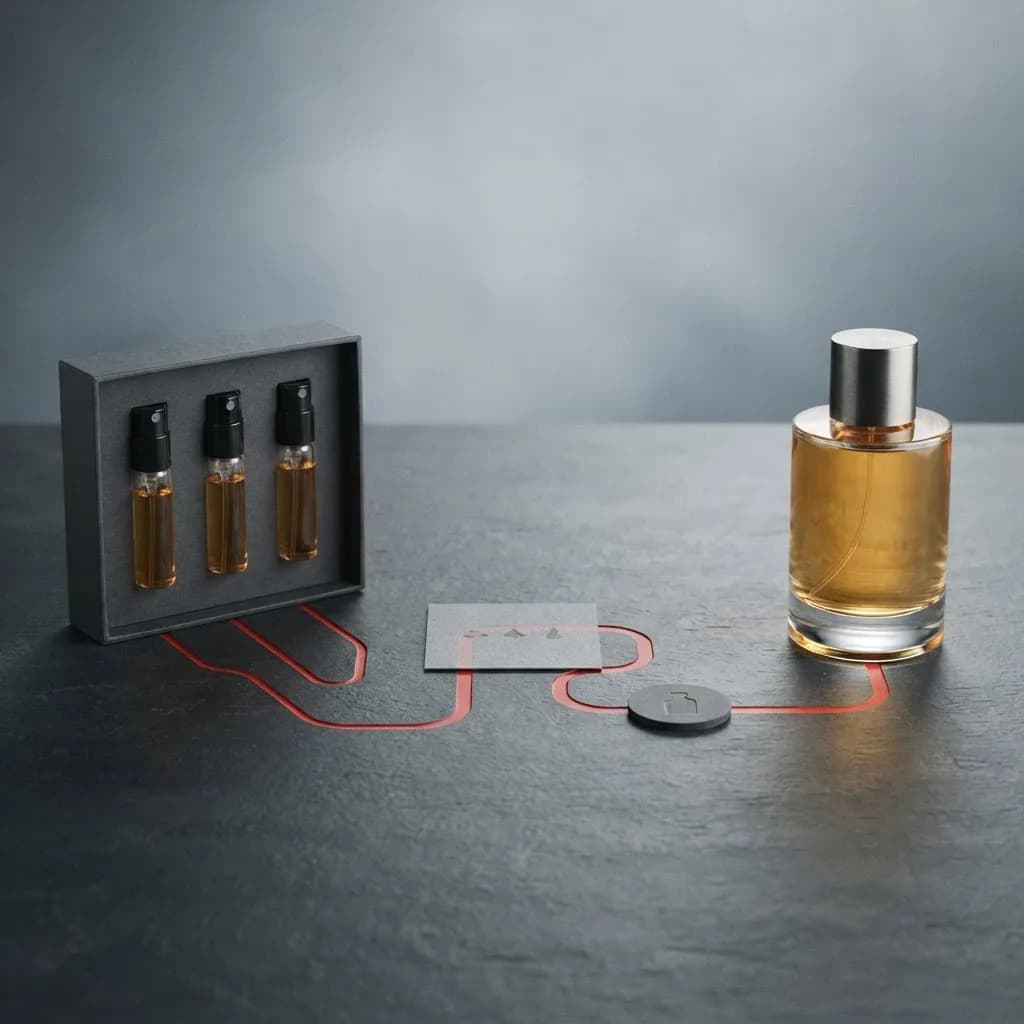
The decision
The decision
A discovery set converts when it helps the right buyer choose, gives that buyer a clear reason to return and makes the move to a full bottle economically coherent. Treat sampling as an acquisition journey: define the audience, price the set deliberately, capture permission for follow-up, reduce choice friction and measure bottle purchases by cohort.
What matters
What matters
- Design the set to enable a decision, not display every SKU.
- Define discovery set conversion and its measurement window before launch.
- Use full or partial sample credit only when the economics and behavior justify it.
- Build follow-up around scent selection, not generic reminders.
- Measure contribution and bottle intent by source and cohort.
What is discovery set conversion?
Discovery set conversion is the movement from a paid or qualified sample experience to a higher-value commercial action, usually a full-bottle purchase. The cleanest metric is the percentage of eligible discovery-set customers who buy a bottle within a defined period.
Sample-to-bottle conversion is a narrower version of the same idea. State whether gifted sets, retail samples, refunded orders and repeat discovery-set buyers are included. State the time window and how cross-device purchases are matched. A metric without cohort rules cannot guide investment.
The purpose is not to force every sampler into a bottle. Sampling also helps unsuitable buyers opt out before a costly return. A useful system improves confident selection while protecting the brand from indiscriminate discounting.
What should the denominator include?
Use customers who received a valid set and had enough time to decide. Separate paid sets, complimentary creator sets and retail sampling because their intent differs. Report unmatched orders honestly rather than assigning conversion without evidence.
Configure tracking and follow-up around valid permission, clear expectations and the privacy requirements of each operating market; obtain qualified advice where needed.
How should the discovery offer be structured?
Begin with the decision the buyer must make. A tightly edited set can be stronger than a complete archive because it reduces fatigue and lets the brand explain meaningful contrasts. Organize by mood, material, intensity or occasion only when that structure helps selection.
Pricing should reflect strategic intent. A free set can maximize requests and weak intent. A fully paid set can qualify buyers but create a larger jump to the bottle. A credited set can reduce that jump, but the credit is an acquisition cost and must be modeled as such.
Show the bottle price before checkout. Hiding the eventual commitment can increase sample orders while reducing qualified bottle intent. Explain volume, concentration, number of wears, shipping terms and credit conditions in plain language.
Should the full discovery-set price become bottle credit?
It depends on margin, desired qualification and likely abuse. Full credit can make the set feel risk-free, but it may train customers to view the samples as a coupon. Partial credit can preserve value while rewarding progression.
Recommendation: compare contribution after sample production, packaging, pick-and-pack, shipping subsidy, payment fees, credit redemption and acquisition spend. Then test one clear mechanic long enough to read behavior.
What follow-up turns smelling into choosing?
The follow-up journey should begin when the set arrives, not when a generic promotional calendar has space. First confirm delivery and explain how to test: one scent at a time, on skin, across development, with notes on context and preference.
Next help the buyer discriminate. Ask which scent remained compelling after several wears, which felt easiest to inhabit and what prevented a decision. Use answers to route education, not to manufacture false personalization.
The final sequence should make the commercial path explicit: recommended bottle, available format, valid credit, deadline if genuine, delivery expectations and access to human help. Avoid relentless countdowns that undermine an otherwise considered brand.
Why generic email sequences underperform
A generic sequence repeats campaign copy instead of resolving selection friction. The sampler already knows the brand exists. They need help interpreting the experience, comparing options and justifying the next commitment.
Use behavior carefully: scent-guide clicks, product revisits, preference responses and credit use can indicate intent. Do not claim precision the data cannot support.
How do you evaluate discovery-set economics?
Calculate contribution across the whole cohort, not only the set order. Include discovery revenue, bottle revenue within the window and any subsequent relevant purchases. Subtract product and packaging cost, fulfillment, shipping support, discounts, credits, payment fees and attributable acquisition cost.
A set may lose money on the first order and still be rational if subsequent contribution is measured and repeatable. It is not rational merely because sampling is common in fragrance. The burden is to show that the system creates qualified customers at a cost the brand can support.
Compare sources separately. Organic brand search, creator seeding, paid social and retail events can produce different set buyers and conversion patterns. Shift budget toward sources that produce bottle contribution, not simply cheap sample orders.
Questions founders ask
What is a good discovery-set conversion rate?
Use your own defined cohorts and contribution economics rather than an unsupported universal benchmark. Rates vary with price, traffic source, assortment, credit mechanics and measurement window.
How long should the conversion window be?
Choose a window that reflects delivery time and repeated skin testing, then keep it consistent. Review shorter and longer windows separately if your buying cycle is uncertain.
Should discovery sets be free?
Free sampling may be appropriate in high-intent retail or tightly selected outreach. For broad online acquisition, payment can qualify intent and offset cost. Test the model against bottle contribution.
Evidence and methodology
This article uses cohort measurement, contribution economics and customer-journey analysis. Recommendations are strategic, not universal benchmarks. Any claims about privacy, consumer rights, shipping or market compliance require jurisdiction-specific verification before publication or implementation.
Reader questions
Ask about this article
Questions are private by default. We may publish an edited question and answer only after moderation; your name and email are never published.
Keep pressure-testing
Related decisions.
 Sequence investment before scaling
LAUNCH STRATEGY
9 min read
How to Launch a Niche Fragrance Brand Without Burning the First €50K
A practical framework for deciding what to validate first, where early budgets are usually wasted and which commercial signals matter before scaling.
 Select creators by commercial fit
CREATOR SEEDING
10 min read
Fragrance Influencer Seeding: How to Measure What Actually Sells
A performance-focused approach to creator selection, attribution and follow-up — without paying for reach that produces no demand.
 Choose the channel by evidence
DISTRIBUTION
10 min read
Retail vs DTC for Niche Perfume: When Each Channel Makes Sense
A decision framework for choosing direct sales, selective retail or a hybrid model without sacrificing margin, learning or brand coherence.
Stop funding the wrong problem
Find the constraint already costing buyers and margin.
Submit the brand for a fit review first. No payment or platform access is required at application; accepted diagnostics start at $300, and implementation is optional.